

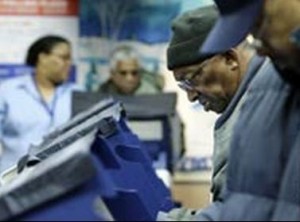
African-American voters cast ballots.
White voters are more likely to say they support voter ID laws if primed with a picture of an African American voting, versus a White person voting, or no picture at all, according to a recent study.
In order to examine the way bias might play a role in support for voter ID laws, researchers with the University of Delaware’s Center for Political Communication conducted an online survey in 2012 of a nationally representative sample of 1,436 adults.
Asked whether they strongly favored, favored, opposed, or strongly opposed voter ID laws, 67 percent of White respondents said they were in favor of such laws when the survey question was accompanied by a picture of a White voter, or no picture at all. When the survey question was accompanied by an image of a Black person voting, 73 percent of White voters said they favored voter ID laws, a statistically significant six percent increase.
The study did not find a similar effect among Black or Latino respondents, but qualified that finding by noting that there were fewer Black and Latino respondents to the survey. Of the 1,436 respondents, 80 percent were White, 11 percent were African American, seven percent were non-White Hispanic, and two percent were Asian.

African-American voters cast ballots.
News of the study’s findings came on the heels of the Supreme Court’s decision to block Wisconsin from implementing its voter ID law in this November’s election. The state had already sent out absentee ballots which failed to inform voters of the requirement to present identification; ignorance of the requirement would have led to those votes being invalidated.
Additionally, a recent report by the non-partisan Government Accountability Office found that not only did voter ID laws in Kansas and Tennessee reduce turnout in the 2012 general election, they did so at greater rates among Blacks than among Whites.
According to that study, “turnout was reduced among African-American registrants by 3.7 percentage points more than among Whites in Kansas and 1.5 percentage points more than among Whites in Tennessee.”
ralejandro@afro.com
